Raising Our Children, Raising Ourselves by Naomi Aldort
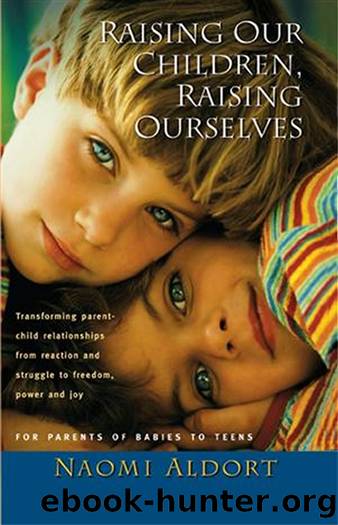
Author:Naomi Aldort
Language: eng
Format: epub
Publisher: Seven Ox Press
Published: 2005-07-14T16:00:00+00:00
The Price of Controlling
When limitations are imposed on the child, she tends to oppose them and to harbor resentment, leading to tantrums or aggression. It can also lead to compliance, which parents often mistake for being a “good” child. The compliant child is likely to show her accumulated distress through other emotional disturbances or later in her teens or adult life with the use of drugs, aggression, eating disorders, depression, and other difficulties.
Helplessness is the key emotion behind rage. We can prevent a child’s helplessness by not taking away her power and by protecting her freedom of choice and self-governing. At the same time, we must avoid burdening her with power beyond her ability to handle, which is often power over others. The combination of helplessness on the one hand and excess power on the other overwhelms a child.
There are situations in which our experience is useful to the child for her safety and well-being. Yet, although there are rare times when we may need to act fast and explain afterwards, in most of life’s circumstances this is not necessary. Instead, when a child is about to do something unsafe or inconsiderate, give her information that she can use to make safe and considerate choices. In this way you avoid the need to act with interventions, limits, and controls that insult her and put you above her.
A child feels powerful when she makes autonomous choices and owns her decisions. However, having autonomy is very different than having control over others, which is scary for a child. If you panic in the face of your child’s emotions she will use her power over you, but having such power overwhelms her and leads to more tantrums.
If most of the time a child is given information so she can make autonomous choices, she will be able to accept situations in which she cannot do whatever she wishes: She cannot ride her tricycle in the middle of the street, break dishes, play with fire, hurt others, hurl objects in the house, or ride in the car without a seat belt. When these realizations are based on constructive communication rather than on control, the child’s natural desire to make the right choices is likely to lead her to doing what is considerate and safe because that is what she wants.
By nature children yearn to do the right things, fit in, be safe, and please us. If your child resists you, it is a sign that you have exercised control in relating to her; you have been resisting her. Whatever you judge in your child is likely to be a useful guide for yourself, so use it for your own growth and your child will improve because you do; she is only mirroring your attitudes. If you see her as resisting, you must be resisting. If she is uncooperative ask yourself how cooperative you are with her. Write down and investigate the thoughts that fuel your need to control; when you shed light on these automatic responses they gradually let you be the parent you love being.
Download
This site does not store any files on its server. We only index and link to content provided by other sites. Please contact the content providers to delete copyright contents if any and email us, we'll remove relevant links or contents immediately.
Should I Stay or Should I Go? by Ramani Durvasula(7667)
The Lost Art of Listening by Michael P. Nichols(7506)
The Rosie Project by Graeme Simsion(6412)
Beartown by Fredrik Backman(5752)
We Need to Talk by Celeste Headlee(5615)
Ego Is the Enemy by Ryan Holiday(5447)
Hunger by Roxane Gay(4927)
Suicide Notes by Michael Thomas Ford(4827)
I Love You But I Don't Trust You by Mira Kirshenbaum(3875)
Mummy Knew by Lisa James(3691)
Not a Diet Book by James Smith(3425)
Crazy Is My Superpower by A.J. Mendez Brooks(3400)
Toxic Parents by Susan Forward(3291)
Girl, Wash Your Face by Rachel Hollis(3282)
The Complete Idiot's Guide to Coping With Difficult People by Arlene Uhl(3149)
The Social Psychology of Inequality by Unknown(3029)
Name Book, The: Over 10,000 Names--Their Meanings, Origins, and Spiritual Significance by Astoria Dorothy(2987)
The Hard Questions by Susan Piver(2972)
The Gaslight Effect by Dr. Robin Stern(2793)
